
Printing the human–robot connection.

We print materials that sense touch, store information, and supply energy — building the foundations of flexible interfaces between people and robots.

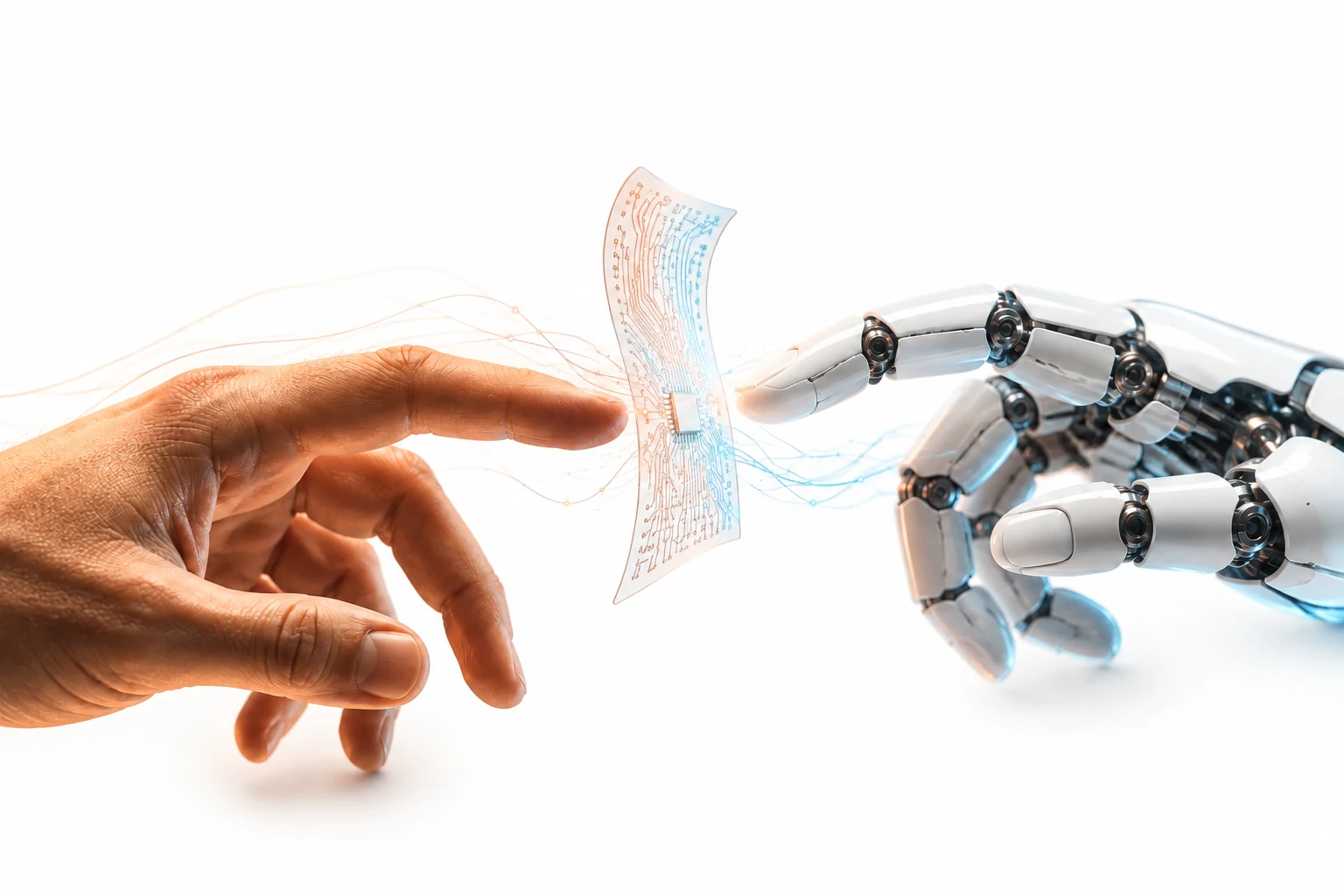
Human and robotic hands meeting across a flexible printed electronic film. AI-generated research concept, not an experimental photograph. Human and robotic hands meeting across a flexible printed electronic film. AI-generated research concept, not an experimental photograph.
People make the connection
Graduate students welcome

Bring your curiosity.
Build what connects.

How can a material sense a touch, hold information or supply energy? Bring your questions to PPEL. We welcome graduate students who want to explore printed electronics and the interfaces between people and robots.

  • Materials & printing
  • Sensing & interfaces
  • Flexible energy
PPEL research team sharing a meal
Different perspectives. Shared curiosity.Meet the team →
At a glance

PPEL on one screen

Tap a tile to jump to that section.

Research Impact

The science behind the connection

We explore sensing, information storage and energy as building blocks for human–machine interfaces. Each study below develops or examines a part of this wider vision of connecting people and robots.

Animated dramatization · figures from the paper, not experimental footage.Film source ↗

AI-Powered Printed Electronics

How can a material read the way we move?
A sheet of mulberry paper can do more than carry words. Contact and separation generate electrical signals; machine learning then looks for patterns. Our featured study explores how paper properties affect this signal and its use in classifying foot health conditions.
Machine LearningScreen PrintingInkjet
Animated dramatization · figures from the paper, not experimental footage.Film source ↗

Bioprinting & Biosensors

How do biological signals become readable data?
Pencil graphite starts a new career as tree-like graphene. In the featured study, this material supports an electrochemical sensor for 5hmC, a marker in DNA. A portable wireless potentiostat sends measurements to a mobile app.
GrapheneDNA SensingWireless
Animated dramatization · figures from the paper, not experimental footage.Film source ↗

Printed Memory Devices

What lets a material store information?
A material can store information through different electrical resistance states. Our featured review surveys carbon-based resistive-switching materials and the mechanisms behind them, bringing together routes toward future memory devices.
RRAMCarbon MaterialsReview
Animated dramatization · figures from the paper, not experimental footage.Film source ↗

Piezo & Triboelectric Energy Harvesting

Could a touch generate its own sensing signal?
A tap can become a signal. The featured study uses cherry blossom petals in a triboelectric nanogenerator and analyzes single- and double-tap signals for gesture recognition. The touch creates the sensor signal; the accompanying electronics are separate.
NanogeneratorGesture RecognitionTENG / PENG
Principal Investigator

Meet Our Professor

Professor Sooman Lim
Dr. Sooman Lim
Professor
Graduate School of Flexible and Printable Electronics, Jeonbuk National University
Contact Professor Google Scholar

Research Interests

Human–Machine Interface Printed Electronics Electronic Skin & Sensors Flexible Energy AI-Enhanced Manufacturing

Contact Information

Email: smlim@jbnu.ac.kr
Office: Engineering Building 9, Room 300
Phone: +82-63-270-4259

Academic Achievements

  • 127 peer-reviewed journal papers published since 2016
  • 3,049+ citations with an h-index of 30 and i10-index of 78
  • 17 patents filed with 11 granted, including 1 technology transfer to industry
  • 27 research projects funded by government agencies and industry (2016–2026)
  • 5 books and book chapters
2012
Ph.D. in Chemical & Image Science
Specialization in Printed Electronics and Materials
Western Michigan University, USA
2008
M.S. in Printing & Information Engineering
Focus on Advanced Printing Technologies
Pukyong National University, Korea
2006
B.S. in Printing & Information Engineering
Graduated with Honors
Pukyong National University, Korea
2016 ~ present
Professor
Graduate School of Flexible and Printable Electronics
Jeonbuk National University
2016
Principal Research Scientist
BASF Korea
2015
Postdoctoral Researcher
Sungkyunkwan University, Korea
2012 ~ 2014
Postdoctoral Associate
Dept. of Chemical Engineering and Materials Science
University of Minnesota, USA

Honors & Awards

  • 2026 Mid-Career Academic Award, Korea Flexible & Printed Electronics Society (KFPE)
  • 2023 Future Talent Award for research excellence, Jeonbuk National University

Professional Service

  • 2024 to present, Member, Printed Electronics (IEC TC 119) Expert Committee, KATS
  • 2026 to present, Project Leader, IEC TC 119 international standard proposal
  • 2026 to present, Guest Editor, Materials Chemistry Frontiers (RSC)
  • 2024 to present, Expert Reviewer, National Registry of Important Science and Technology Records
  • 2022 to present, Evaluation and Planning Committee Member for defense R&D (ADD, KRIT, Korea Institute of Civil-Military Technology Cooperation)
  • 2019 to present, R&D Evaluation Committee Member, Ministry of SMEs and Startups (TIPA and others)
  • 2019 to present, Evaluation Committee Member for government and local programs (Public Procurement Service, NRF, Jeonbuk State and others)

Current Research Focus

Our research connects materials science and printed electronics with the wider vision of human–robot interaction. We study flexible sensing, biosensors, information storage and energy devices, alongside AI-assisted analysis and printing processes. These individual research directions inform the interfaces that may connect people and machines.

Recent Achievements

  • 2026 KFPE Mid-Career Academic Award
  • 2026 Project Leader, IEC TC 119 international standard proposal
  • 2026 Review on printed energy materials in Progress in Materials Science (IF 37.4)
  • 2025 Published in ACS Nano (IF 15.8) on ultra-sensitive DNA detection
  • 2024 Selected for NRF Mid-Career Researcher Program
  • 2023 Future Talent Award for research achievement
The People

Lab Members

An international research community of postdoctoral researchers, doctoral students, and undergraduate students.

Postdoctoral
Dr. Habibulla Imran
Dr. Habibulla Imran
Postdoctoral Researcher
Ph.D. Students
Omkar Patil
Omkar Patil
Ph.D. Student
Qasim Raza
Qasim Raza
Ph.D. Student
Swarali Joshi
Swarali Joshi
Ph.D. Student
Aqila Che Ab Rahman
Aqila Che Ab Rahman
Ph.D. Student
Rafiq Muheeb
Rafiq Muheeb
Ph.D. Student
Undergraduate Students
Heejung Shin
Heejung Shin (신희정)
Undergraduate Student · Electronics Engineering
Alumni
Omkar Pawar
Omkar Pawar
Ph.D. 2026
Hai Li
Ph.D. 2024 · Professor, Jiangxi Science & Technology Normal University
Asrar Alam
Ph.D. 2023 · Postdoctoral Researcher, Stanford University
Xue Qi
Ph.D. 2022 · Postdoctoral Researcher, Harbin Institute of Technology (Shenzhen)
Hoseong Song (송호성)
M.S. 2020 · Public enterprise
Muhammad Zeeshan Asghar
M.S.
Ali Shan
Ali Shan
M.S.
0
Total Citations
0
Publications
0
h-index
0
Patents
0
Research Projects
Output

Research Publications

Selected from 127 peer-reviewed papers published since 2016 · journal IF > 10 or JCR top 10% in its field. Browse by year.

Computational Simulation

Experiments show what happens.
Simulation shows why.

We run DFT and COMSOL in-house, from the electronic structure of atoms to stress and electric potential across whole devices. In 13 of our published papers these calculations explain why our materials and devices behave as they do. Molecular dynamics (MD) is coming soon.

From atoms to devices

DFT

Å · Atoms and electrons
Density functional theory

Why does this material behave this way?

  • Charge transfer at interfaces (charge density difference, Bader charge)
  • Dipole moment and polarization
  • Adsorption and binding energy of molecules such as O₂ and glucose
  • Electronic structure (DOS/PDOS) and how adsorption shifts it
  • Band structure, work function, doping, defect and surface models
Quantum ESPRESSO

MD

Coming soon
nm · Molecules and interfaces
Molecular dynamics

How do molecules and ions move and pack?

  • Diffusion coefficients and ion transport in electrolytes
  • Polymer–filler interface interactions
  • Mechanical and thermal behavior of polymer chains
Joining DFT and COMSOL soon

COMSOL

µm–mm · Devices and fields
Finite element multiphysics

How does the device respond to force, charge and ions?

  • Piezoelectric potential under load, compared across structures
  • Crack growth and strain in printed sensors under tension
  • Triboelectric potential and electric field distribution
  • Stress in bending, pressing and microneedle insertion
  • Diffusion, reaction and heat transfer in sensors and batteries
COMSOL Multiphysics

Used in our published papersAlso available

Examples from our papers

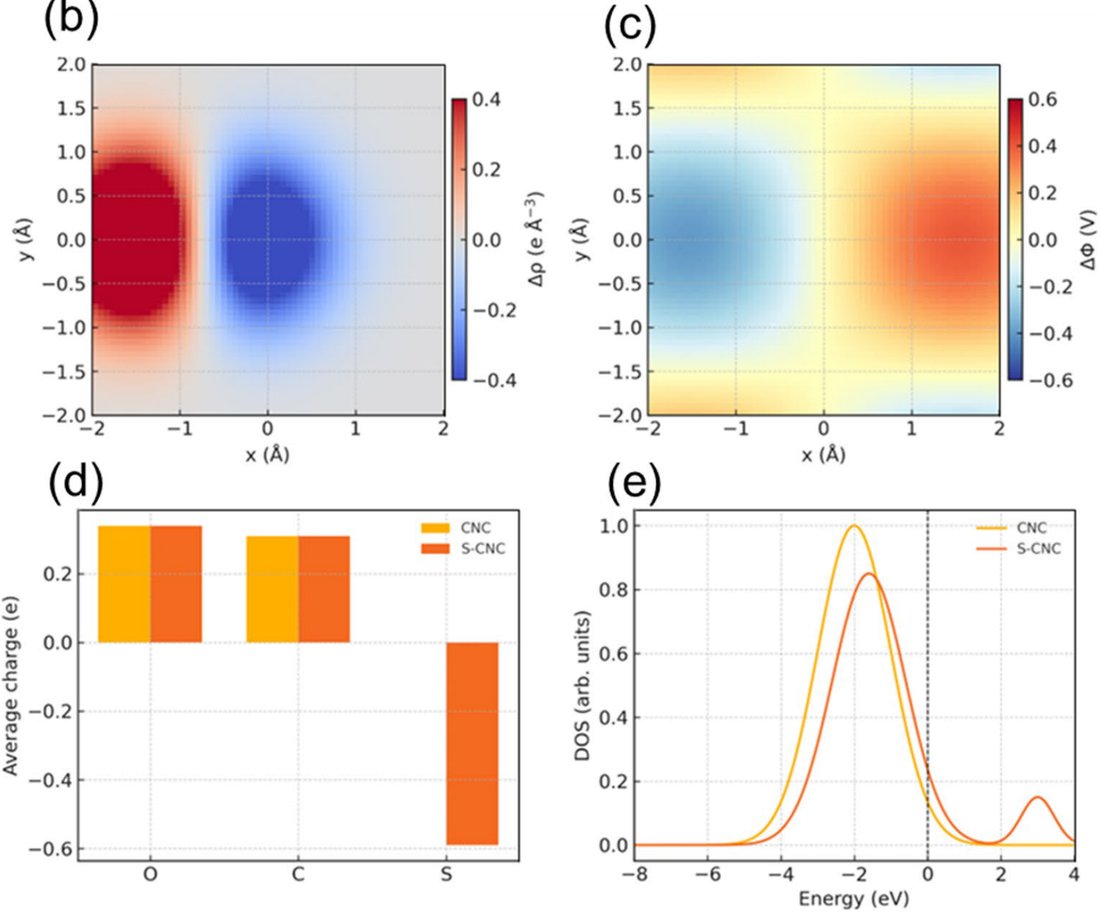
DFT maps of charge density difference and electrostatic potential difference, Bader charges and projected density of states for pristine and sulfated cellulose nanocrystals
DFT Sulfate groups pull charge and raise the unit-cell dipole moment from 3.2 D to 11.0 D. Source: Adv. Compos. Hybrid Mater. 9 (2026) 205 · CC BY 4.0 ↗
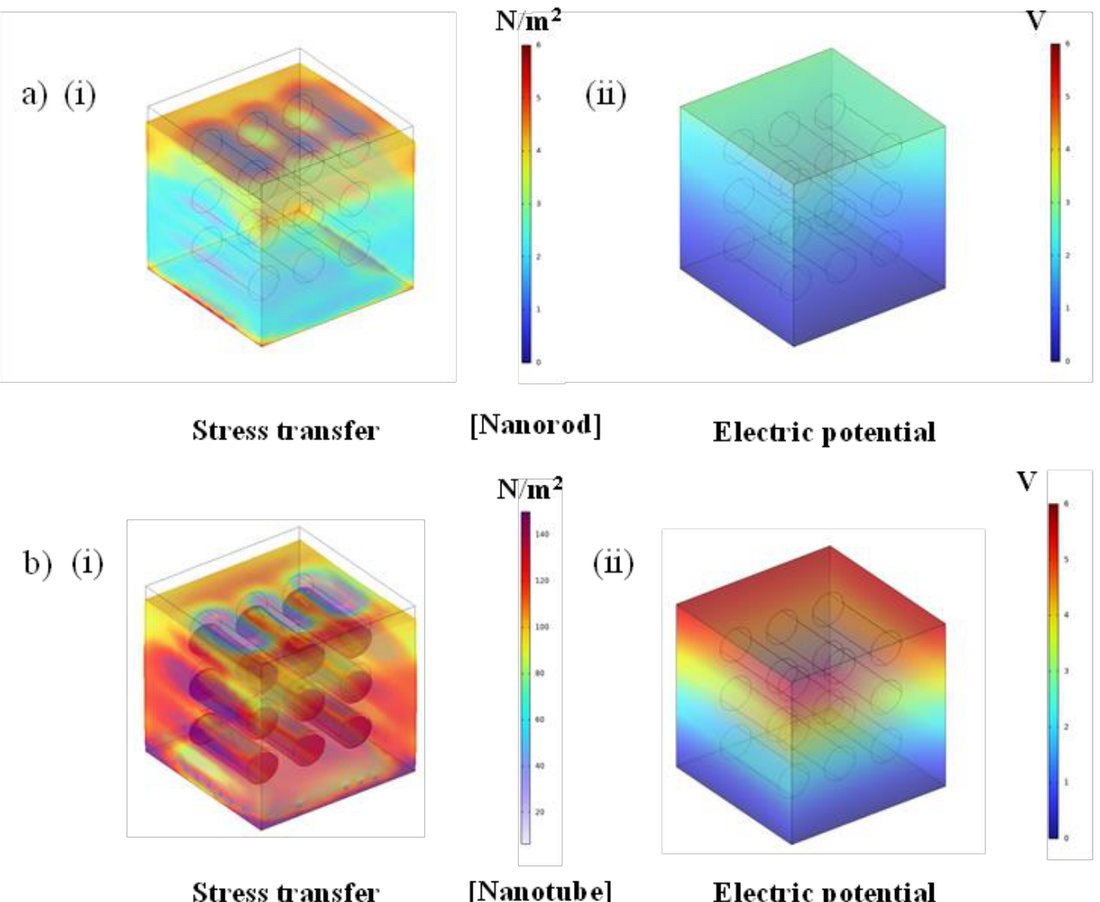
COMSOL maps of stress transfer and electric potential in PVDF composites with g-C3N4 nanorods and nanotubes
COMSOL Nanotubes pass on more stress than nanorods and build a larger piezoelectric potential. Source: Chem. Eng. J. 519 (2025) 165069 ↗
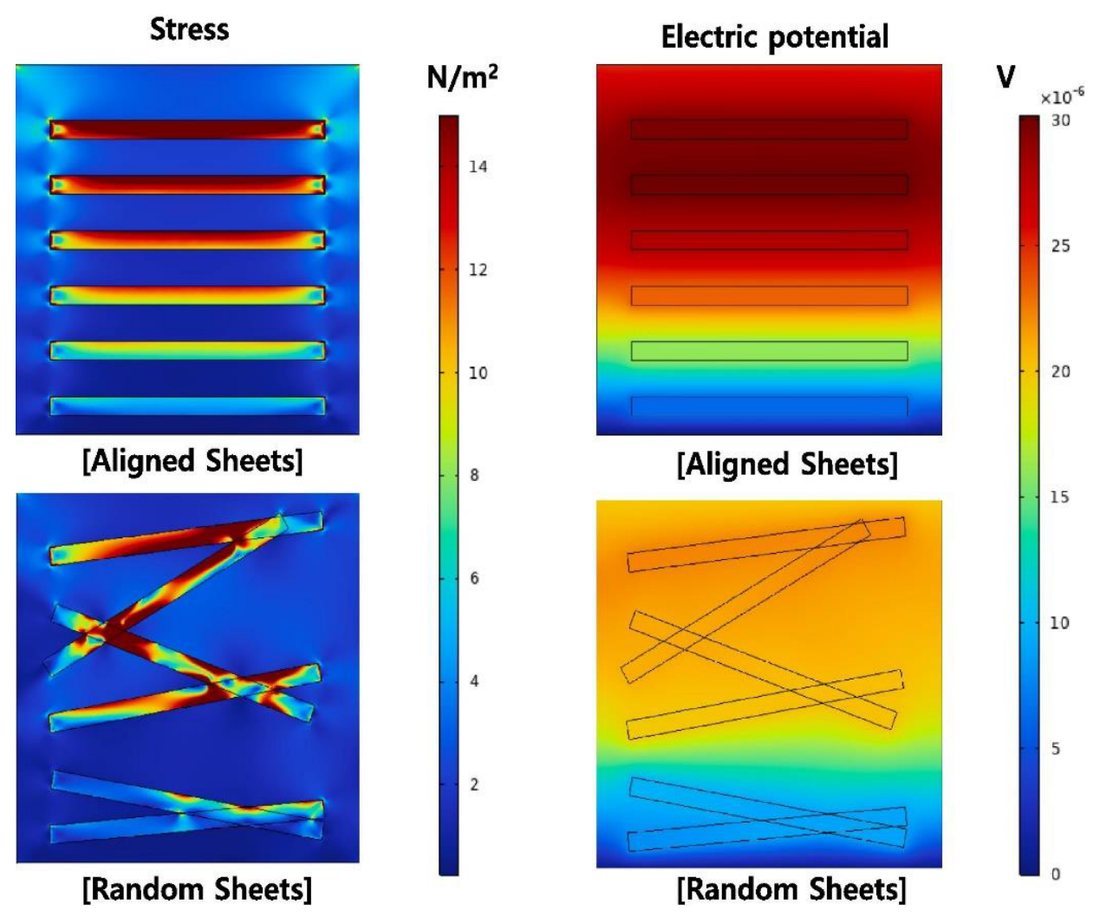
COMSOL maps of stress and electric potential for aligned and randomly oriented g-C3N4 nanosheets in PVDF
COMSOL Aligned nanosheets share stress evenly and give a steadier potential than random ones. Source: J. Colloid Interface Sci. 654 (2024) 868 ↗

Published with our simulations

13 papers · DFT 11 · COMSOL 5
  1. 2026
    Sulfated Cellulose Nanocrystals into Piezoelectricity: A New Material for Piezoelectric Energy Harvesting and Smart Strain Sensing for Health Monitoring

    DFT: dipole moment 3.2 D → 11.0 D (3.4×) · COMSOL: higher piezoelectric potential under load · Advanced Composites and Hybrid Materials

    DFTCOMSOLIF 21.8▶ Film
  2. 2026
    Oxygen-scavenging MnO₂ nanoparticles enabled thermally stable and oxidation-resistant MXene inks for 3D-printed flexible asymmetric supercapacitors

    DFT: MnO₂ interacts with oxygen first, shielding MXene from oxidation · Advanced Composites and Hybrid Materials

    DFTIF 21.8▶ Film
  3. 2026
    DFTIF 16.8▶ Film
  4. 2026
    Ti₃C₂Tₓ MXene Nanosheets: Bridging High-Performance Energy Storage and Comprehensive In Vivo Biocompatibility Assessment

    DFT: the metallic Ti–C backbone and O/F terminations work together for fast electron transport · ACS Applied Materials & Interfaces

  5. 2026
    First-Principles Investigation of Glucose Adsorption and Sensing-Related Electronic Modulation on Ti₃C₂O₂ MXene

    DFT: glucose adsorption (−0.82 eV) and the electronic change it causes on the sensing surface · Micromachines

  6. 2026
    Viscosity-engineered cellulose acetate/g-C₃N₄ triboelectric nanogenerators for self-powered UV/force dual-stimulus sensing

    DFT: stronger charge redistribution at the exposed g-C₃N₄/PTFE contact · COMSOL: an electrostatic model reproduces the voltage trend · Chemical Engineering Journal

    DFTCOMSOLDOI ↗
  7. 2026
    Breathable mulberry paper-based theranostic patch integrating 3D-printed microneedles for drug delivery and wireless sweat-wicking uric acid sensing

    DFT: Au₁₃ on NiO(100) lowers the work function by 1.47 eV (7.38 → 5.91 eV) · Chemical Engineering Journal

  8. 2026
  9. 2026
    Defect-tailored Fe-NiCr₂O₄ nano-spinel for efficient solar-light responsive photocatalysis and water disinfection

    DFT: Fe substitution adds shallow Fe 3d states at the band edges · Journal of Alloys and Compounds

  10. 2025
    Structural transformation of graphitic carbon nitride from 2D to 1D architectures for enhanced piezoelectric performance

    COMSOL: why hollow nanotubes raise piezoelectric output · Chemical Engineering Journal

    COMSOLIF 13.4
  11. 2025
    Highly Efficient 3D-Printed PVDF-Based Triboelectric Nanogenerators Featuring Polymorphic Perovskite Nanofillers

    DFT: FAPbI₃ fillers reshape the electrostatic potential of PVDF · COMSOL: charge distribution in the TENG · Advanced Functional Materials

    DFTCOMSOLDOI ↗
  12. 2025
    Development of a wireless vitamin B2 sensor by using flexible and disposable screen-printed electrode modified with g-C₃N₄ based ternary composite

    DFT: Y–Zr co-doping narrows the band gap and gathers electrons at metal–nitrogen sites · Analytica Chimica Acta

  13. 2022
    A Screen-Printed Metal Hybrid Composite for Wireless Wind Sensing

    COMSOL: crack growth under tension explains how the printed sensor changes resistance · Nanomaterials

    COMSOLDOI ↗

Joint research and commissioned calculations are also possible. smlim@jbnu.ac.kr ↗

Intellectual Property

Patents

Korean patents filed and granted through the JBNU Industry-Academic Cooperation Foundation.

17 Total 11 Granted 5 Pending 1 Tech Transferred
2026
Pore-Controlled Mulberry-Paper-Based High-Performance Triboelectric Nanogenerator and AI Healthcare Monitoring System Using the Same
ProvisionalKR 10-2026-0083129
2025
Electrochemical Sensor Device for On-Site Detection of Riboflavin
PendingKR 10-2025-0122407
2025
Screen-Printed Electrode for Electrochemical Detection of Quercetin and Manufacturing Method Thereof
PendingKR 10-2025-0068289
2025
DLP Printing Composition Containing PMMA
PendingKR 10-2025-0050988
2024
Piezoelectric Film for Piezoelectric Nanogenerators and Manufacturing Method Thereof
GrantedKR 10-2024-0044354
2024
Spray Paint for Electrostatic Coating, Manufacturing Method and Coating Method Using the Same
PendingKR 10-2024-0020580
2023
Eco-Friendly Color Ceramic Paint Composition for Electrostatic Coating and Manufacturing Method Thereof
GrantedKR 10-2023-0195512
2023
Screen-Printed Carbon Electrode for Capsaicin Detection and Manufacturing Method Thereof
Tech TransferredKR 10-2023-0161484
2023
Three-Dimensional Polymer–Nanostructure–Liquid Ternary Composite for Piezoelectric Nanogenerators and Manufacturing Method Thereof
GrantedKR 10-2023-0139801
2023
Electrochemical Sensor Based on Carbon-Nitride-Modified Gold Transducer for 5-Hydroxymethylcytosine Detection and Manufacturing Method Thereof
GrantedKR 10-2023-0129371
2023
Ultrahigh-Energy-Density Flexible Asymmetric Supercapacitor and Manufacturing Method Thereof
GrantedKR 10-2023-0123266
2023
Three-Dimensional Porous Piezoelectric Device, Manufacturing Method Thereof, and Piezoelectric Nanogenerator Including the Same
GrantedKR 10-2023-0010884
2022
Polymer–Nanodroplet Composite, Manufacturing Method Thereof, SL-PENG Including the Same, and Electronic Device Comprising It
GrantedKR 10-2022-0045597
2021
Printing Composition for Piezoelectric Devices, Manufacturing Method Thereof, and Printer for Piezoelectric Devices Using the Same
GrantedKR 10-2021-0104866
2020
Piezoelectric Material Composite, Film and Manufacturing Method Thereof, and Sensor Using the Film
GrantedKR 10-2020-0149629
2020
Manufacturing Method of Hanji-Based Graphene Strain Sensor and Strain Sensor Produced Thereby
GrantedKR 10-2020-0064711
2019
Strain Gauge, Strain Sensor Including the Same, and Strain Measurement Method Using the Same
GrantedKR 10-2019-0059812
Granted patents are marked with a blue left border · tech-transferred with a green border
Global Network

International Collaborations

Partnerships with leading research institutions worldwide.

United States
University of Minnesota
USA
China
Tsinghua University
China
Japan
Institute of Science Tokyo
Japan
Germany
Technical University of Munich
Germany
United Kingdom
Imperial College London
United Kingdom
Singapore
National University of Singapore
Singapore
Inside the Lab

Equipment

35 instruments for fabrication, processing and measurement.

Electrochemical & Electrical Measurement

06
  • 01
    Electrochemical workstation (potentiostat/galvanostat)전기화학 워크스테이션 (정전위기/정전류기)
  • 02
    Electrochemical impedance spectroscopy (EIS) analyzer전기화학 임피던스 분광(EIS) 분석기
  • 03
    Digital storage oscilloscope디지털 저장 오실로스코프
  • 04
    Source Measure Unit (SMU)소스 측정 장치 (SMU)
  • 05
    Impedance analyzer임피던스 분석기
  • 06
    Piezoelectric d33 meter압전 d33 측정기

Mechanical & Materials Testing

05
  • 07
    Contact angle analyzer접촉각 분석기
  • 08
    Motorized linear / reciprocating motion stage전동 직선 / 왕복 운동 스테이지
  • 09
    Motorized cyclic compression testing setup전동 반복 압축 시험 장치
  • 10
    Rotational viscometer / rheology measurement system회전형 점도계 / 유변 물성 측정 시스템
  • 11
    Universal testing machine / tensile tester만능 재료 시험기 / 인장 시험기

Printing & Fabrication

07
  • 12
    Laboratory screen-printing machine실험실용 스크린 인쇄기
  • 13
    DLP 3D printer (polymer resin)DLP 3D 프린터 (폴리머 레진)
  • 14
    DLP 3D printer (ceramic resin)DLP 3D 프린터 (세라믹 레진)
  • 15
    DIW printerDIW 프린터
  • 16
    Film coating machine필름 코팅기
  • 17
    Laboratory gravure / roll-printing machine실험실용 그라비어 / 롤 인쇄기
  • 18
    FDM 3D printerFDM 3D 프린터

Microscopy & Probing

02
  • 19
    Optical microscope with digital camera디지털 카메라 장착 광학 현미경
  • 20
    Semiconductor probe station with optical microscope광학 현미경 장착 반도체 프로브 스테이션

Heat Treatment & Drying

04
  • 21
    Vacuum drying oven진공 건조 오븐
  • 22
    Large vacuum oven대형 진공 오븐
  • 23
    Hot-air drying oven열풍 건조 오븐
  • 24
    Bench top Furnace탁상형 전기로

Sample Preparation & Mixing

11
  • 25
    Laboratory centrifuge실험실용 원심분리기
  • 26
    Refrigerated laboratory centrifuge냉장 원심분리기
  • 27
    Analytical balance분석용 저울
  • 28
    Electrospinning apparatus with syringe pump시린지 펌프 장착 전기방사 장치
  • 29
    Analytical / micro balance분석용 / 미량 저울
  • 30
    Planetary centrifugal mixer유성 원심 혼합기
  • 31
    Ultrasonic bath초음파 수조
  • 32
    Ultrasonic Probe sonicator프로브형 초음파 분산기
  • 33
    Six-position hot-plate magnetic stirrer6구 가열판 자력 교반기
  • 34
    Vortex mixer볼텍스 혼합기
  • 35
    Hot-plate magnetic stirrer가열판 자력 교반기
Lab Arcade

Ink Runner: print a circuit on the fly

A one-minute arcade built from what we do every day. Steer the print head along a moving roll-to-roll film, lay a conductive trace across the pads, lift over dust, thread the cracks, and keep an eye on your ink.

INK RUNNER
PPEL+ printed-electronics arcade
Move: mouse, touch or ↑↓ · Print: hold click, touch or Space · P pause
Click inside the frame if the keys stop responding. Best scores are saved in this browser.
Open in a new tab ↗
PadPrint across it to connect. Combos multiply the score.
DustLift the head to pass. Ink on dust shorts the circuit.
CrackFly through the gap. Contact costs a nozzle.
InkRefills the tank. A gold flash sinters every pad on screen.